
 Mastodon
 PeerTube
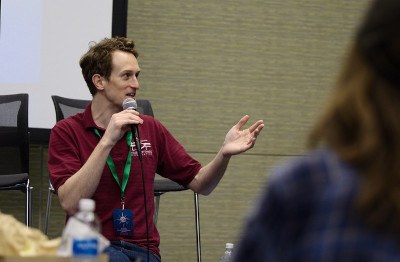
Meet FSF President Ian Kelling
By Zoë Kooyman, FSF Executive Director & Ian Kelling, FSF President and Senior Systems Administrator
The Free Software Foundation (FSF) has been looking for a new president ever since Geoffrey Knauth committed to leaving the position in 2021. Filling this position was not easy. There are general requirements that need to be satisfied, like where the person is located or confirmation there are no conflicts of interest. Besides these qualifications, we needed someone knowledgeable of the free software issues we're facing, and who is excited to work with the staff and myself to push the FSF forward and grow the free software movement!
Read More - Index
Introducing Mission:Libre, a new project for teens
By Carmen Maris, Mission:Libre founder
If a movement is going to thrive, it has to appeal to the young — they'll be the ones to inherit it, after all. Free software is no exception. A bright future for free software depends on young people choosing to build and support it. Teenagers are often courageous activists, and they are at a critical phase in their development to make choices that could lead them to become powerful forces for software freedom! It is so important that there are programs that appeal and communicate the ethics and goal of the free software movement to these developing activists. Projects like the Free Software Foundation Europe’s Youth Hacking 4 Freedom are certainly an important part of outreach to teens, but teens also need long-term programs that can educate them about the free software movement and how to be responsible future stewards.
Read More - Index
Why you shouldn't use a lax license for your next free software program
By Krzysztof Siewicz, Licensing and Compliance Manager
Software freedom is about controlling your computing. This means having the freedom to run, copy, distribute, study, change, and improve the software. We determine whether a program is free based on what kind of license it is under and there generally exist two kinds of free software licenses. A copyleft license, e.g., the GNU General Public License (GPL), or the GNU Affero General Public License (AGPL), requires all distributors of a program to keep that program free, as well as any derivative works based on changes made to it. Conversely, a lax license (e.g., various versions of the BSD license) allows distributors to not share the program or its modifications, thus denying downstream users control over their own computing.
Read More - Index
New Nintendo DRM bans consoles, makes users beg for forgiveness
By Miles Wilson, summer 2025 campaigns intern
In the lead up to its Switch 2 console release, Nintendo updated its user agreement and asserted broad authority to make consoles owned by its customers permanently unusable. Under Nintendo's most aggressive digital restrictions management (DRM) update to date, game console owners are now required to give Nintendo the unilateral right to revoke access to games, security updates, and the Internet, at its sole discretion.
Read More - Index
Don’t be fooled by Amazon’s claims that Ring video doorbells give you freedom and security
By Michael McMahon, GNU/Linux Systems Administrator
Mass surveillance, and legislation supporting it, is on the rise in the Western world. We have seen examples in the Australian Surveillance Devices Act, the French Intelligence Act, and the American PATRIOT Act. At the FSF we also regularly receive reports of threats to privacy. To pick only one example: the number of surveillance cameras in Romania has massively increased in all kinds of places, including stairways of apartment complexes, private and public parking lots, roofs of corporate and government buildings, government buildings, hospitals, metro stations, public parks, churches, schools, kindergartens, and universities, trains and buses and pedestrian road crossings. Some of these cameras upload their video footage to websites, where one can watch the public space 24/7.
Read More - Index


